Case study 7 : Spreading rumours and fake news: learning to check information

The context: spreading rumours and fake news

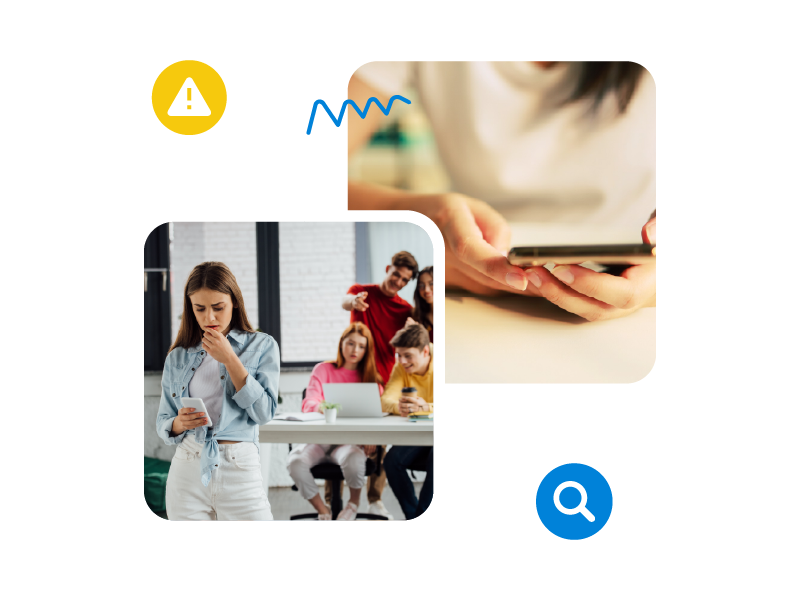
Maya, 14, is very active on Snapchat and TikTok. She regularly shares videos and articles she finds interesting. Her parents, Aline and François, are proud of her curiosity, but they notice that Maya is starting to repeat worrying information seen online without checking the source. This reflects a gap in media and information literacy, a key skill for navigating today’s digital ecosystem.

Exposition aux contenus violents

The problem: unintentionally spreading false content

The situation gradually gets worse, illustrating several mechanisms:

Le basculement

Social amplification

The stories she shares spark tense discussions with her friends, creating an echo chamber where beliefs are reinforced without being checked against facts.

La menace

Algorithmic influence

Recommendations of sensationalist videos increase credulity and feed confirmation bias, as Maya is exposed to ever more radical content by predictive recommendation systems.

Icône emprise

Emotional stress

Maya feels responsible when her posts cause arguments. She shows social anxiety linked to the fear of disappointing people or losing her online reputation.

Déclic : la situation de sécurité numérique repérée

The wake-up call

One morning, Aline receives messages from other parents reporting that Maya shared false information about a classmate. She understands it was not malicious, but a lack of source-checking skills. This marks a turning point, moving from a logic of punishment to one of educational mediation.

How Vigiloo helped

The system enabled an approach combining prevention, education and support:

Icône changement de tonalité

Content analysis

Detection of frequent sharing of unverified information through a source reliability algorithm based on fact-checking databases.

Icône mots-clés de chantage

Educational alerts

Contextual notifications encouraging dialogue rather than punishment, following a non-violent communication approach.

Protocole d'urgence

Learning guides

Interactive tools to teach Maya to cross-check sources, recognise disinformation tactics and use fact-checking methods.

The results

Maya is developing information metacognition: she is starting to question her sharing reflexes and to apply mental filters before passing on content.

Conflicts with her friends quickly decrease, thanks to better relational skills and a greater ability to defuse rumours.

The parents have discreet, educational monitoring that does not create fear, encouraging parental co-regulation rather than intrusive control.

logiciel de contrôle parental et de sécurité numérique des enfants - Vigiloo

Guide 10
Intelligence artificielle et enfants :

comprendre, encadrer, accompagner

Guide 9
Les 20 erreurs

que font les parents avec les écrans

Guide 8
Majorité numérique

droits et devoirs à 13,15,18 ans

Guide 7
6–10 ans

Premières règles numériques pour bien commencer

Guide 6
Arnaques, phishing et fausses promesses

Comment les enfants se font piéger

Guide 5
Empreinte numérique

Le manuel de survie des parents connectés

Guide 4
La parentalité numérique à l’ère des smartphones

nouveaux défis, nouvelles solutions

Guide 3
Internet et enfants

les 15 règles d’or pour les parents

Guide 2
Décrypter les jeux en ligne

Ce que les parents doivent savoir

Guide 1
Réseaux sociaux et enfants

Identifier les risques et sécuriser leur usage avec Vigiloo